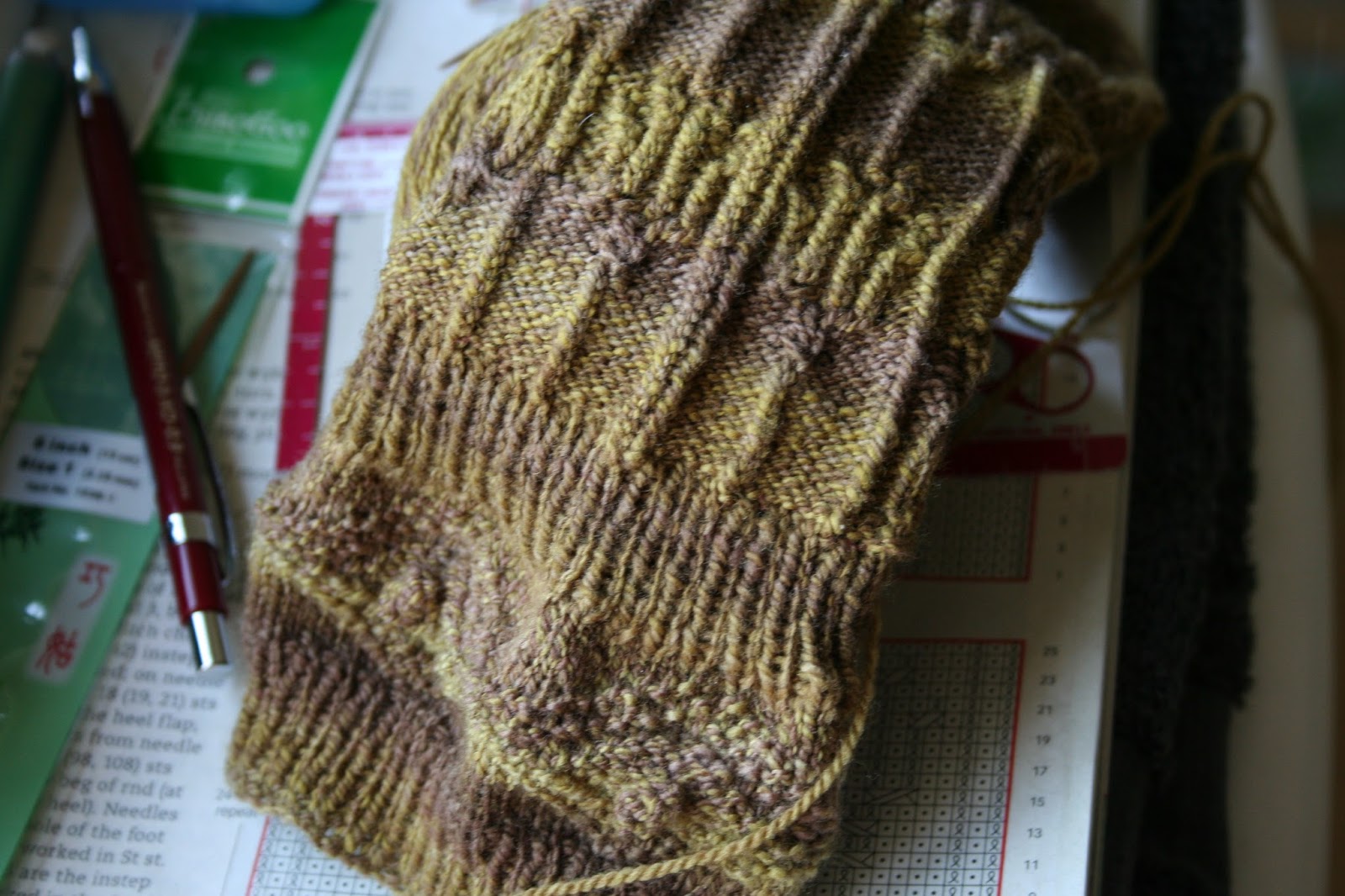
I can't remember exactly when I technically began this project, but I can tell you that it took me roughly 3ish months to finally get the yarn spun for this project. As many of you know, I'm usually a busy person, so getting 500+ yards of a 2-ply lace weight yarn finished in a timely manner isn't feasible. But it's done. You can read about my troubles getting the gauge correct here.
I had been dreaming of these socks for a while, basically since I first saw them in July 2013 while visiting the States. I usually tend to buy knitting magazines when I know that I'll make at least 10-15% of the projects. That brings the price per pattern into the 'reasonable' range. The Unofficial Harry Potter Knits magazine contained about 6-7 projects I really wanted to work on, which came down to about 40% of the patterns in the magazine. The Dragon Egg socks probably would have been my first project if I already had the right yarn and yardage. It turned out to be my second project from this magazine (the Gray Lady cloak being my first), but I'll talk about that other project later. I'm warming up to it.
First, I'll say that what really got me interested in these socks was the fact that they were unisex. I may look very girly, but I'm not super big into girly things like lace (let's not talk about the lace cloak). The pattern had texture and interesting combinations of stitch patterns, but they weren't overtly feminine--a good thing in a unisex sock! The stitches also seemed like they would hold up to my kind of wear and tear. The directions were easy to follow, the stitches themselves weren't anything new, and it seemed like this was a great pattern to use to break away from the standard stockinette stitch or ribbed socks. And I was right.
Now, let's talk about bobbles. Apparently, not all bobbles look good with certain yarn/needle combos. My bobbles look funny. I've understood the concept of how to make bobbles for a while now, but this was actually the first time I have made bobbles. I'm not really a fan of them. In fact, in combination with the first chart, the dragon's egg chart, I think they look awful. I almost wish I could just knit my second sock without the dragon's egg chart. The sock bulges at that point and makes the sock look strange. I know I haven't blocked it yet, but I can't imagine it will smooth out too much...but wool can be amazing. We'll see after they're both washed and blocked.
The heel is probably one of my favorite sections of this sock. That's boring, I know. It's a slip stitch heel so it's more durable that a stockinette heel, and because of the slipping of stitches, it has less elasticity than a ribbed heel. I'm convinced that I won't have droopy heel syndrome with these socks, and I'm fairly certain that these heels will last forever. I'm still that obnoxious kid who never unties her shoes before taking them off; a durable heel is key for me.
Last, let's focus on the top-side (Quidditch) pattern after the heel is finished. Remember how I said these are unisex socks? Well, it would probably be better to call these 'socks for the average male foot and for the above average female foot.' Okay, so it also gives the dimensions in the pattern. For the smallest size (ie, the woman's size), knit the Quidditch pattern until the sole length measures 8 inches, or 2 inches smaller than the actual size of the foot. I don't have very large feet (in fact they've shrunk after so much martial arts training and long distance running), so my sock needs to be at 7 inches by the time I begin the decreases for the toe shaping. The Quidditch pattern is (in)conveniently 2 inches long for the whole repeat. Well, poo. My short foot means that I'll have to cut the Quidditch pattern short and in an awkward spot. In the end, I decided to just start knitting the whole rest of the foot in stockinette and decrease when it got to 7 inches. The model has a nice finish where the pattern transitions into toe, but mine has this strange extra bit of nothingness. I guess it looks okay, but now I doubt my decision to just stop the pattern. Perhaps I could have made up something? I'll think about that if I make these again.
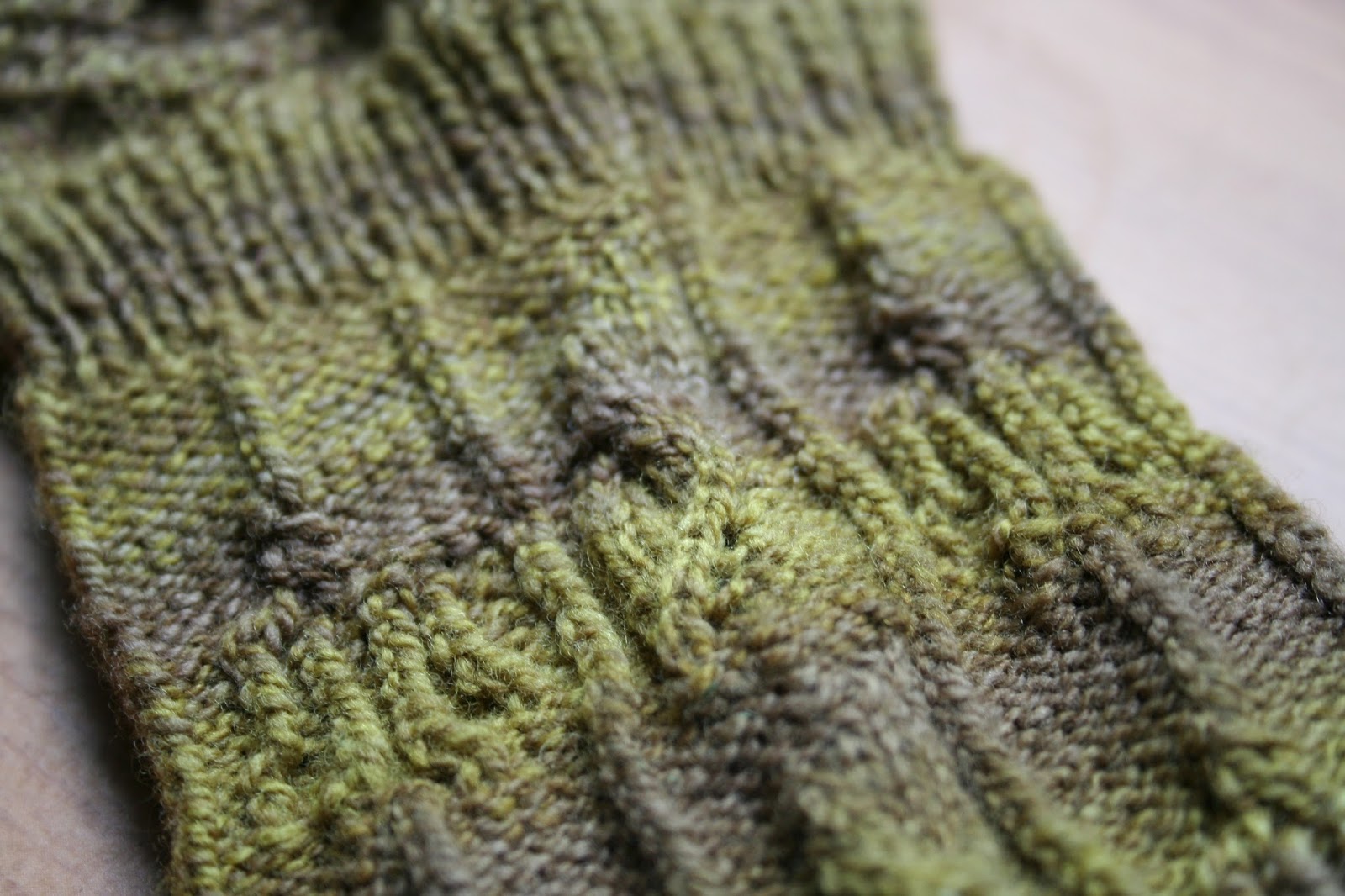
Overall, I really liked this pattern. I was never confused for a moment during any of the written or charted instructions. I've made only a couple of pairs of socks, so I'd say that this could easily be a great sock pattern for anyone in my boat. However, I would change a couple of things. I would definitely make these socks again without the dragon egg chart, but I would also add another repeat of the Quidditch chart to keep it at the longer length. I would also devise a truncated version of the Quidditch chart for the last repeat near the toe...perhaps I'd make mini broomsticks or mini snitches. Or something less intricate.
Now, before you tell me I should make both socks and wash/block them before I write a review, I wanted to say that this is the point which makes or breaks a pair of socks. I want to make the second one, but I have serious doubts about my first sock. It looks nice when I try the sock on, but will the dragon egg chart get saggy on my calf? Now is the time to make decisions about whether to make the second one and see how well it turns out after washing and blocking, or to take the first one apart and start over with something you might like better. I'm hesitant, but I'm confident that wool keeps it's shape well while being worn all day. I'm going to make sock #2 just like sock #1. And if I don't like how they wear after actually putting some mileage on them, I'll ask the internet how to remove the cast on edge of a sock and replace it with something else. Because I thought of it, it must exist, right? That's the law of internet information.
Spinning with wool is one of my greatest passions. Here, I'll share with you tips and tutorials to inspire you, as well as share the projects I'm currently working on.
Tuesday, April 29, 2014
Thursday, April 24, 2014
Mini Review: Spin-Off Magazine Spring 2012
This is an old review I did for the Spring 2012 issue of Spin-Off magazine, which featured Lincoln wool. It's fun to read through things you've written in the recent past. My experience reading this magazine was of great excitement because I hadn't read any books or magazines which focused solely on fibers and handspun yarns. In light of my future reviews of Spin-Off, Ply, and various books, I thought I would post this so you could see how Spin-Off impacted me more than 2 years ago. Cue the time machine!
Originally posted on March 8, 2012:
Hey everyone! While I'm still working on trying to get this white cormo yarn to take great pictures, I figured I'd put up a little post about a widely read spinning magazine, Spin-Off. With a subscription, you'll also get access to member-only downloads regarding fiber prep and spinning techniques on a regular basis, as well as some other things. These are some nice perks, but what's inside each issue is where the real prize lies.
Because I belong to my local guild and have access to our guild's library, I've had a chance to read many of the back issues of Spin-Off, some of which were from the early 1990s--yes, the projects in those issues were VERY dated. :) The ads have obviously changed, but the general layout and the goals of magazine have stayed relatively the same. So, without further ado, let's chat about the most recent issue, Spring 2012.
The magazine always starts off with some paid advertising and book reviews, as well as "letters to the editor." I'm paraphrasing here. The stuff they talk about in the front matter is informative, and if I had the money/time, I would probably read most of those books based solely on the reviews. They also have a section entitled "Armchair Traveler"--or something like that--where they take the reader to some part of the world to talk about the types of wool you'll find there and some key places you must visit if you happen to visit that locality. As an anthropologist, I kind of smirk at the title, since it hearkens back to the days of early Anthropology, where there were "Armchair Anthropologists/Archaeologists"--basically, they were financiers who had an interest in other cultures or an obsession with artifacts but otherwise could not or would not travel to those far off locations to pursue scientific work; no, that was left up to the educated people who were surely underpaid by their employers. Sigh, tangent over.
The middle chunk of the magazine is dedicated to: 1) teaching new spinning techniques; 2) talking about fiber prep; 3) focusing on a specific fiber; 4) controversial issues; 5) ...you're getting the idea. Anyway, this issue focuses on Lincoln longwool. If you've never had the chance to spin it/dye it/knit it, well, I (and the Spin-Off writers) think you're missing something. It's a strong, thick, shiny, long-stapled wool that is sadly underused. It may not be perfect for a scarf or mittens, but Spin-Off comes to its rescue to educate its readers on how important, and rare, this breed is. If you want to know more, Spin-Off is still available for purchase, so stop by your local yarn shop or craft shop and pick up a copy. If you like it, I'd suggest getting a subscription.
They also had this fantastic article about where the twist stops when a spinning wheel is your tool. I actually didn't really give it much thought prior to reading this article, but afterwards, you can bet that I've begun to notice where the twist stops now! I like how the author writes the article too, since she takes you through this narrative of scientific method bloopers and "A-ha!" moments.
There was also a nice article about flicking locks and combing locks, which inspired me to drag out some Lincoln locks and dye them..I don't have normal fiber combs, but I've found that hair picks work just as well, if only a bit awkward to use. Those locks are on the drying rack right now, so I'll tell you how it goes later.
The project in this issue focuses on how to use Lincoln wool, how it should be spun, how it feels when spun properly, and the kinds of uses its best for. They chose a beautiful crocheted market bag to show off Lincoln wool's ability to withstand abrasion and weight. And boy, does it sure look good doing it! I'll need to either get better at crocheting, or I'll need to find a knitted alternative for a market bag. I have 3 ounces of Lincoln top that I want to dye now, so I'll need to pick out a pattern soon! :D
If you liked this little mini-review post, I'm hoping to do more in the future. I don't get the chance to read many books since I'm pretty busy, but I'll do them as often as I can.
Originally posted on March 8, 2012:
Hey everyone! While I'm still working on trying to get this white cormo yarn to take great pictures, I figured I'd put up a little post about a widely read spinning magazine, Spin-Off. With a subscription, you'll also get access to member-only downloads regarding fiber prep and spinning techniques on a regular basis, as well as some other things. These are some nice perks, but what's inside each issue is where the real prize lies.
Because I belong to my local guild and have access to our guild's library, I've had a chance to read many of the back issues of Spin-Off, some of which were from the early 1990s--yes, the projects in those issues were VERY dated. :) The ads have obviously changed, but the general layout and the goals of magazine have stayed relatively the same. So, without further ado, let's chat about the most recent issue, Spring 2012.
The magazine always starts off with some paid advertising and book reviews, as well as "letters to the editor." I'm paraphrasing here. The stuff they talk about in the front matter is informative, and if I had the money/time, I would probably read most of those books based solely on the reviews. They also have a section entitled "Armchair Traveler"--or something like that--where they take the reader to some part of the world to talk about the types of wool you'll find there and some key places you must visit if you happen to visit that locality. As an anthropologist, I kind of smirk at the title, since it hearkens back to the days of early Anthropology, where there were "Armchair Anthropologists/Archaeologists"--basically, they were financiers who had an interest in other cultures or an obsession with artifacts but otherwise could not or would not travel to those far off locations to pursue scientific work; no, that was left up to the educated people who were surely underpaid by their employers. Sigh, tangent over.
The middle chunk of the magazine is dedicated to: 1) teaching new spinning techniques; 2) talking about fiber prep; 3) focusing on a specific fiber; 4) controversial issues; 5) ...you're getting the idea. Anyway, this issue focuses on Lincoln longwool. If you've never had the chance to spin it/dye it/knit it, well, I (and the Spin-Off writers) think you're missing something. It's a strong, thick, shiny, long-stapled wool that is sadly underused. It may not be perfect for a scarf or mittens, but Spin-Off comes to its rescue to educate its readers on how important, and rare, this breed is. If you want to know more, Spin-Off is still available for purchase, so stop by your local yarn shop or craft shop and pick up a copy. If you like it, I'd suggest getting a subscription.
They also had this fantastic article about where the twist stops when a spinning wheel is your tool. I actually didn't really give it much thought prior to reading this article, but afterwards, you can bet that I've begun to notice where the twist stops now! I like how the author writes the article too, since she takes you through this narrative of scientific method bloopers and "A-ha!" moments.
There was also a nice article about flicking locks and combing locks, which inspired me to drag out some Lincoln locks and dye them..I don't have normal fiber combs, but I've found that hair picks work just as well, if only a bit awkward to use. Those locks are on the drying rack right now, so I'll tell you how it goes later.
The project in this issue focuses on how to use Lincoln wool, how it should be spun, how it feels when spun properly, and the kinds of uses its best for. They chose a beautiful crocheted market bag to show off Lincoln wool's ability to withstand abrasion and weight. And boy, does it sure look good doing it! I'll need to either get better at crocheting, or I'll need to find a knitted alternative for a market bag. I have 3 ounces of Lincoln top that I want to dye now, so I'll need to pick out a pattern soon! :D
If you liked this little mini-review post, I'm hoping to do more in the future. I don't get the chance to read many books since I'm pretty busy, but I'll do them as often as I can.
Tuesday, April 22, 2014
Spinning Long Locks: Reexamining the Tail Spinning Method
A while back, I posted a video about my experience spinning wensleydale lamb locks. They weren't quite long enough for the tail spinning method, but I came up with a nice work-around method which would be suitable for shorter locks. You can see how it turned out in the video below:
I basically secured the wensleydale lock with a strong silk single after I spun the locks as a tail spun yarn. It made the yarn more stable and would hold up to wash and wear. There won't be much yardage with this type of yarn, so it should either be a simple project (simply making crochet chains, for example) or be a feature of a larger project. This particular yarn made suitable fringe for my Cora shawl:
I learned so much about how to make the yarn and ways I could use this type of yarn, so I decided to up the ante and make a tail spun yarn with longer locks. This time, I used teeswater locks which were about 7-8 inches long, but almost any long wool which has a tight lock can be used for this type of yarn. I used a 50/50 nylon/mohair blend lace yarn for a core to help me build some structure into my second attempt at this yarn. Some spinners think that a core yarn is important to add strength to tail spun yarns, while others believe it to be an unnecessary step. I'm testing all sorts of methods because it's the little scientist in me trying to figure out which way is best...if there truly is such a thing as 'best.' :)
In my first attempt with the grey wensleydale locks, I used the fluffy bits of fleece to connect each lock. I spun some straight yarn for about 12 inches to get started, then I began adding in locks. I split the 'roving' down the middle, inserted the base of the lock and wrapped the end of the lock around one leg of the split roving, then held everything together while I added some twist. I spun another inch or two, then split the roving and added another lock. This is one type of tail spinning that I've seen on youtube and on blogs. It spaces the locks a bit more than extreme tail spinning, which basically puts the base of one lock next to the base of the other. In my second attempt at tail spinning, I opted to try the extreme tail spinning method using a core yarn for structure.
In the above picture, I've only just gotten started. Extreme tail spinning takes even longer than tail spinning, since you're placing locks much closer together, thereby shortening the distance between locks and removing the easy parts of the yarn. This is a difficult yarn only by virtue of its tedium. If you have the attention span of a toddler, or tend to be busy nearly every waking moment, pause and keep coming back to this project. It'll help prevent you from feeling overloaded with the kind of patience needed for this sort of project, and it develops a crucial skill for spinners: adaptability.
I've been asked how I go from project to project, in terms of spinning. Well, I have crafter's ADD and I can't sit still. I'm forever pulling out a wheel and spinning for a while, then putting that one away and pulling out the other wheel (or sometimes my spindle), then finally switching to knitting something and back to spinning again. All in a single evening. It stresses Mr. IT Guy out because I can't settle. The point is, I work on projects which inspire me at any given moment. Therefore, I will often spin two very different yarns in the same evening. My hands have learned how to adapt to the yarn I'm spinning very quickly so I don't waste a lot of time stopping to check my gauge every few inches. Working on a crazy art yarn like this and switching to a very traditional yarn is quite a challenge for my hands. I've started and stopped this yarn several times since I began working on it, and every time I come back to it--no matter how long it has been since I last worked on it--I get a little faster at adapting to this spinning method.
At this stage, the yarn is about halfway finished. Before I started, I hand separated each lock and lined them up on paper towels (which I keep reusing!) for stress-free spinning. This step is probably one of the most important steps in making this type of yarn since your fingers tend to be busy doing other things. I spun this in the dark, and as a result, the locks are all beautifully mis-matched. Given my obsessive nature for things to be equal or balanced, I worried that the locks would turn out too uniformly dispersed...but not being able to see the colors very well helped make this yarn look so good! And here it is almost finished:
If you want to know more about how to make this yarn specifically, let me know in the comments below. I'm still somewhat a beginner, but I can definitely offer some tips/tricks to make things go smoothly. It's a bit of a learning curve getting to this point, but I think that if you can make any 'art yarn,' you can tackle this yarn.
I basically secured the wensleydale lock with a strong silk single after I spun the locks as a tail spun yarn. It made the yarn more stable and would hold up to wash and wear. There won't be much yardage with this type of yarn, so it should either be a simple project (simply making crochet chains, for example) or be a feature of a larger project. This particular yarn made suitable fringe for my Cora shawl:
I learned so much about how to make the yarn and ways I could use this type of yarn, so I decided to up the ante and make a tail spun yarn with longer locks. This time, I used teeswater locks which were about 7-8 inches long, but almost any long wool which has a tight lock can be used for this type of yarn. I used a 50/50 nylon/mohair blend lace yarn for a core to help me build some structure into my second attempt at this yarn. Some spinners think that a core yarn is important to add strength to tail spun yarns, while others believe it to be an unnecessary step. I'm testing all sorts of methods because it's the little scientist in me trying to figure out which way is best...if there truly is such a thing as 'best.' :)
In my first attempt with the grey wensleydale locks, I used the fluffy bits of fleece to connect each lock. I spun some straight yarn for about 12 inches to get started, then I began adding in locks. I split the 'roving' down the middle, inserted the base of the lock and wrapped the end of the lock around one leg of the split roving, then held everything together while I added some twist. I spun another inch or two, then split the roving and added another lock. This is one type of tail spinning that I've seen on youtube and on blogs. It spaces the locks a bit more than extreme tail spinning, which basically puts the base of one lock next to the base of the other. In my second attempt at tail spinning, I opted to try the extreme tail spinning method using a core yarn for structure.
In the above picture, I've only just gotten started. Extreme tail spinning takes even longer than tail spinning, since you're placing locks much closer together, thereby shortening the distance between locks and removing the easy parts of the yarn. This is a difficult yarn only by virtue of its tedium. If you have the attention span of a toddler, or tend to be busy nearly every waking moment, pause and keep coming back to this project. It'll help prevent you from feeling overloaded with the kind of patience needed for this sort of project, and it develops a crucial skill for spinners: adaptability.
I've been asked how I go from project to project, in terms of spinning. Well, I have crafter's ADD and I can't sit still. I'm forever pulling out a wheel and spinning for a while, then putting that one away and pulling out the other wheel (or sometimes my spindle), then finally switching to knitting something and back to spinning again. All in a single evening. It stresses Mr. IT Guy out because I can't settle. The point is, I work on projects which inspire me at any given moment. Therefore, I will often spin two very different yarns in the same evening. My hands have learned how to adapt to the yarn I'm spinning very quickly so I don't waste a lot of time stopping to check my gauge every few inches. Working on a crazy art yarn like this and switching to a very traditional yarn is quite a challenge for my hands. I've started and stopped this yarn several times since I began working on it, and every time I come back to it--no matter how long it has been since I last worked on it--I get a little faster at adapting to this spinning method.
At this stage, the yarn is about halfway finished. Before I started, I hand separated each lock and lined them up on paper towels (which I keep reusing!) for stress-free spinning. This step is probably one of the most important steps in making this type of yarn since your fingers tend to be busy doing other things. I spun this in the dark, and as a result, the locks are all beautifully mis-matched. Given my obsessive nature for things to be equal or balanced, I worried that the locks would turn out too uniformly dispersed...but not being able to see the colors very well helped make this yarn look so good! And here it is almost finished:
If you want to know more about how to make this yarn specifically, let me know in the comments below. I'm still somewhat a beginner, but I can definitely offer some tips/tricks to make things go smoothly. It's a bit of a learning curve getting to this point, but I think that if you can make any 'art yarn,' you can tackle this yarn.
Tuesday, April 8, 2014
Crafting and Drafting
Can it be done? Writing drafts of papers and having time to craft, I mean. The first time through proved to be impossible. But it could also be the fact that it has been about 4 years since I last had to write an important paper--my dissertation. I'm probably a little rusty, and couldn't find the dang oil can.
My first draft has been submitted to my favorite editor, Christine from CBC Editing. She's been editing my papers since around 2007, and in my not so humble opinion, she's the best. She knows exactly what you need out of an editing experience, and her impossibly positive attitude makes you feel like a billion bucks. More importantly, she does an excellent job at everything: conversing with you about your needs or concerns, delivering the paper back to you in a timely manner, and offering opinions which make solid papers in the end. My draft is in good hands.
The writing experience has been a tough one. Not the kind of tough where I rewrite the whole thing because I didn't like where it was going. I had a ridiculous time getting out the gate. It felt like I was trying to separate sludge into neat piles. Gross metaphor? How about: It felt like I was trying make muffins on a baking sheet. Mmm. Muffins. Mr. IT Guy has this wonderful habit of wearing treads in the floor as he walks back and forth hashing out his ideas in his head--something I recently adopted so I could write my arguments more coherently on the first shot. It helped, but it still didn't feel like it was working. So I sat down and wrote.
And it was terrible. It was literally 5 days of "Well, this could go here..." and "When should I talk about..?" Even with an outline, I still had a terrible mess. I remember thinking that I should just finishing knitting my sock(s). Or maybe I should replace my drive band on Beth which has been broken for a week. Meh. I just didn't feel like tackling any projects. Perhaps I was stuck in my bored phase? Hmm...probably not.
I made progress in my head, just thinking about stuff. The papers I was reading were leading me to exciting places in my mind. But every time I tried to write them down in a logical order, it felt like nailing jello to the wall. Every time I thought about dragging some fiber out to spin something new--maybe I just needed a new project--I just stopped and stared at the wall like a cat. ^-^
These next several weeks will show me if crafting and drafting can be done. Once I get some much needed help with the organization of my paper (Christine is a magician because she always turns my ideas into things which actually make sense), I won't have these writing woes anymore. So, will I feel inspired to get some crafting done while I work on my final rough draft? I hope so. My crafting table is starting to look like a fibery wasteland. I swear I saw a tumbleweed made of angelina and sari silk blow by me when I was cleaning earlier last week.
My first draft has been submitted to my favorite editor, Christine from CBC Editing. She's been editing my papers since around 2007, and in my not so humble opinion, she's the best. She knows exactly what you need out of an editing experience, and her impossibly positive attitude makes you feel like a billion bucks. More importantly, she does an excellent job at everything: conversing with you about your needs or concerns, delivering the paper back to you in a timely manner, and offering opinions which make solid papers in the end. My draft is in good hands.
The writing experience has been a tough one. Not the kind of tough where I rewrite the whole thing because I didn't like where it was going. I had a ridiculous time getting out the gate. It felt like I was trying to separate sludge into neat piles. Gross metaphor? How about: It felt like I was trying make muffins on a baking sheet. Mmm. Muffins. Mr. IT Guy has this wonderful habit of wearing treads in the floor as he walks back and forth hashing out his ideas in his head--something I recently adopted so I could write my arguments more coherently on the first shot. It helped, but it still didn't feel like it was working. So I sat down and wrote.
And it was terrible. It was literally 5 days of "Well, this could go here..." and "When should I talk about..?" Even with an outline, I still had a terrible mess. I remember thinking that I should just finishing knitting my sock(s). Or maybe I should replace my drive band on Beth which has been broken for a week. Meh. I just didn't feel like tackling any projects. Perhaps I was stuck in my bored phase? Hmm...probably not.
I made progress in my head, just thinking about stuff. The papers I was reading were leading me to exciting places in my mind. But every time I tried to write them down in a logical order, it felt like nailing jello to the wall. Every time I thought about dragging some fiber out to spin something new--maybe I just needed a new project--I just stopped and stared at the wall like a cat. ^-^
These next several weeks will show me if crafting and drafting can be done. Once I get some much needed help with the organization of my paper (Christine is a magician because she always turns my ideas into things which actually make sense), I won't have these writing woes anymore. So, will I feel inspired to get some crafting done while I work on my final rough draft? I hope so. My crafting table is starting to look like a fibery wasteland. I swear I saw a tumbleweed made of angelina and sari silk blow by me when I was cleaning earlier last week.
Monday, March 31, 2014
Time, I have it: Boredom
Things with my semi-retirement status are going fabulously. You know those moments when you think, "I can't spend too much time doing X because I won't have enough time for Y and it'll throw my setup for tomorrow morning off schedule?" Well, no more. I have plenty of time to enjoy whatever X is still have enough time to get Y done, and still sleep in on a Saturday morning. I've always pushed myself to do many things, mainly because I don't believe in 'boredom.' Well, I should clarify. Boredom is good to have occasionally, but disasterous and digressive if frequently and in quantity.
During these last couple of weeks, I've been bored--like, laying on my back, making funny, nonsensical sentences, and giggling uncontrolably to myself. That kind of bored. Don't get me wrong, I've also been extremely productive with my paper, answered questions and emails, sent out orders, and even filmed two videos--but it's worth having mental stability to be bored from time to time. When was the last time you did...nothing...for an hour? I mean, stared-at-a-wall type nothing?
Remember when your parents would notice you being 'bored' or hear you complain about 'there's nothing to do,' what did they say? Go clean your room. Why don't you help me wash the dishes? When was the last time you played with Z toy? Manual labor always made me find creative ways to prevent being identified as 'bored'--who wants to dishes as a kid, especially when I'll have 50 years of dish washing ahead of me anyway?
Boredom has a negative stigma. Maybe it was our clever parents who inserted the idea of it being negative and thus we are the creative people we are today. Or maybe it's just the brain arguing with itself about whether or not 'doing nothing' is really productive...and it turns out the latter. Whatever the scientific reason is, being bored gives the brain the downtime it needs to reset, often in the middle of the day. And it's different than napping. Because we're conscious, ideas flow freely and we can be aware of them. In my most recent 'bored' session, I thought of an interesting way to make textured yarn without much work. I hope to have more of these productive 'bored' sessions in the future.
I think that once I get my new schedule settled, I'll be able to capitalize on these 'bored' sessions a bit more: new techniques, more time for practice and refinement, etc. These next few weeks will be devoted to finishing my rough draft and editing it. For now, the schedule is a bit bumpy and I can't say exactly when I'll get new content out to ya'll. When the paper is submitted, I hope to continue posting to the blog every few days and get a video out about once a week, as well as posting things often to FB, Twitter, and Instagram. Thank you to everyone who has supported this decision as it does encourage me to keep going, just at a sustainable pace. No more sad faces..I'm still here to hang out and learn and teach and make yarn!
During these last couple of weeks, I've been bored--like, laying on my back, making funny, nonsensical sentences, and giggling uncontrolably to myself. That kind of bored. Don't get me wrong, I've also been extremely productive with my paper, answered questions and emails, sent out orders, and even filmed two videos--but it's worth having mental stability to be bored from time to time. When was the last time you did...nothing...for an hour? I mean, stared-at-a-wall type nothing?
Remember when your parents would notice you being 'bored' or hear you complain about 'there's nothing to do,' what did they say? Go clean your room. Why don't you help me wash the dishes? When was the last time you played with Z toy? Manual labor always made me find creative ways to prevent being identified as 'bored'--who wants to dishes as a kid, especially when I'll have 50 years of dish washing ahead of me anyway?
Boredom has a negative stigma. Maybe it was our clever parents who inserted the idea of it being negative and thus we are the creative people we are today. Or maybe it's just the brain arguing with itself about whether or not 'doing nothing' is really productive...and it turns out the latter. Whatever the scientific reason is, being bored gives the brain the downtime it needs to reset, often in the middle of the day. And it's different than napping. Because we're conscious, ideas flow freely and we can be aware of them. In my most recent 'bored' session, I thought of an interesting way to make textured yarn without much work. I hope to have more of these productive 'bored' sessions in the future.
I think that once I get my new schedule settled, I'll be able to capitalize on these 'bored' sessions a bit more: new techniques, more time for practice and refinement, etc. These next few weeks will be devoted to finishing my rough draft and editing it. For now, the schedule is a bit bumpy and I can't say exactly when I'll get new content out to ya'll. When the paper is submitted, I hope to continue posting to the blog every few days and get a video out about once a week, as well as posting things often to FB, Twitter, and Instagram. Thank you to everyone who has supported this decision as it does encourage me to keep going, just at a sustainable pace. No more sad faces..I'm still here to hang out and learn and teach and make yarn!
Tuesday, March 25, 2014
The New Ply Magazines Have Arrived!
Spin-Off magazine has be the foremost magazine available to spinners who want to be part of a community and learn more about their craft through the experiences of others. As a commercial magazine, available at many craft stores around the world, it has become a popular choice for spinners to read as each issue becomes available. There are other, slightly more academic, peer-reviewed journals which discuss various aspects of spinning, about it's history, but those aren't typically available on the commercial market--to access those, you must pay for a subscription. Occasionally, there is a brief mention about spinning in knitting and crocheting magazines. Herein lies the perfect balance between the content you'd get from a Spin-Off issue, and that of paid subscription to a peer-reviewed journal: Ply magazine. It has a structured overview with well-written, fluff-free articles which teach the reader in a very reproducible, scientific way. I'll explain all what I mean in a later blog post, but I wanted to talk about my first impressions of the magazine.
First, the magazine itself is printed on sturdy paper, with a completely different feel than magazine paper. This attention to detail, whether intended as such or not, makes me feel like the content I'm about to read will be flipped through many times, so heavier paper is needed for durability. The coverart decidedly makes me feel less like I'm reading a magazine. The sleek, unobtrusive cover allows me to see the art for what it is and easily know the contents of the issue (Color, Woven, etc.). After a quick flip and skimming the contents, it becomes apparent that great attention was paid to unifying all of the diverse content together with theme other than white pages.
The advertisements in Ply are well integrated into the pages, and I rarely feel like I need to skip over them. There's a rare page or two of nothing but advertisements, but on the whole, it seems like they are either fewer in number than Spin-Off or placed such that I don't notice that I'm being sold to. I really like having advertisements nearby an article, yet unobtrusive. I realize the importance and necessity of having advertisements in a magazine, however it can make me feel like I'm watching regular cable television--I'm way more likely to skip past pages of advertisements rather than read them.
Overall, it seems like the content is updated. Though it focuses on a specific theme, in this case, Color, I think it reflects many of the questions I get asked about color blending and how to spin batts/roving to achieve various color effects. I find this to be a bit of a surprise, given the fact that this is a printed resource--often, printed sources tend to be behind the times. The salient questions about color are addressed, and since the advertisements are played down, I feel like I'm both getting plenty of content and the pictures they use show me exactly what they're talking about. In some ways, it looks like a teaching manual.
Last, the price. I must admit, I wasn't too sure about the steep price. I bought mine from a store in Japan, Kakara Woolworks, since Yuka was the closest store to me who had copies (and thus the cheapest shipping price). For me it was USD $16 an issue, but a subscription for US addresses is $9 an issue (and probably around $10 an issue if you buy it at a store). That is certainly more for 4 issues than Spin-Off, which is about $6.50 per issue. My cursory look has given me confidence that I paid an appropriate amount for the extras offered to me in each issue, so if you might be on the fence about purchasing a copy (or getting a subscription), I'd say it's worth examining personally.
I'll be working through each page, each article, so I can write up a review which takes a closer look at the actual content. I do this for every Spin-Off magazine too, and with the new issue for Spring arriving soon, I'll soon be able to compare the content of each magazine. And as a side note, I don't dislike Spin-Off. It's a typical magazine in terms of its layout, and I learn many things in every issue I have, which starts in Spring 2010. I've even read the older issues from the late 80s/early 90s that my guild library had. I just think Ply is heading in a new direction and really speaks to me as an avid learner, plus it seems like a strong contender for the market. It's nice to have choices, and I think Ply offers a healthy amount of competition. In all likelihood, I'll subscribe to both, especially since I know that many of you come to me with questions and I like helping out in any way I can. Anyway, stay tuned for more about Ply magazine! <3
First, the magazine itself is printed on sturdy paper, with a completely different feel than magazine paper. This attention to detail, whether intended as such or not, makes me feel like the content I'm about to read will be flipped through many times, so heavier paper is needed for durability. The coverart decidedly makes me feel less like I'm reading a magazine. The sleek, unobtrusive cover allows me to see the art for what it is and easily know the contents of the issue (Color, Woven, etc.). After a quick flip and skimming the contents, it becomes apparent that great attention was paid to unifying all of the diverse content together with theme other than white pages.
The advertisements in Ply are well integrated into the pages, and I rarely feel like I need to skip over them. There's a rare page or two of nothing but advertisements, but on the whole, it seems like they are either fewer in number than Spin-Off or placed such that I don't notice that I'm being sold to. I really like having advertisements nearby an article, yet unobtrusive. I realize the importance and necessity of having advertisements in a magazine, however it can make me feel like I'm watching regular cable television--I'm way more likely to skip past pages of advertisements rather than read them.
Overall, it seems like the content is updated. Though it focuses on a specific theme, in this case, Color, I think it reflects many of the questions I get asked about color blending and how to spin batts/roving to achieve various color effects. I find this to be a bit of a surprise, given the fact that this is a printed resource--often, printed sources tend to be behind the times. The salient questions about color are addressed, and since the advertisements are played down, I feel like I'm both getting plenty of content and the pictures they use show me exactly what they're talking about. In some ways, it looks like a teaching manual.
Last, the price. I must admit, I wasn't too sure about the steep price. I bought mine from a store in Japan, Kakara Woolworks, since Yuka was the closest store to me who had copies (and thus the cheapest shipping price). For me it was USD $16 an issue, but a subscription for US addresses is $9 an issue (and probably around $10 an issue if you buy it at a store). That is certainly more for 4 issues than Spin-Off, which is about $6.50 per issue. My cursory look has given me confidence that I paid an appropriate amount for the extras offered to me in each issue, so if you might be on the fence about purchasing a copy (or getting a subscription), I'd say it's worth examining personally.
I'll be working through each page, each article, so I can write up a review which takes a closer look at the actual content. I do this for every Spin-Off magazine too, and with the new issue for Spring arriving soon, I'll soon be able to compare the content of each magazine. And as a side note, I don't dislike Spin-Off. It's a typical magazine in terms of its layout, and I learn many things in every issue I have, which starts in Spring 2010. I've even read the older issues from the late 80s/early 90s that my guild library had. I just think Ply is heading in a new direction and really speaks to me as an avid learner, plus it seems like a strong contender for the market. It's nice to have choices, and I think Ply offers a healthy amount of competition. In all likelihood, I'll subscribe to both, especially since I know that many of you come to me with questions and I like helping out in any way I can. Anyway, stay tuned for more about Ply magazine! <3
Monday, March 17, 2014
Semi-Retirement: A Harsh Reality
I am putting Expertly Dyed into semi-retirement very soon. I'll explain what 'semi' retirement means, but first, let me explain why I've come to this decision. For most of you, I think this will come as quite a surprise.
Last August, I was faced with a seriously unexpected turn of events, and I was being forced to shut down the Etsy shop for Expertly Dyed. I was heading back to Korea, and with no one to ship goods on my behalf in the States anymore, I didn't see how I could possibly keep that running. My in-laws stepped in to help, but it was a temporary setup. I set things up with my mom so I could dye wool imported from Japan, but here are the problems: Time. Stress. Ability. Coordination. It may seem like a sweet deal to have people do the leg work for me, but all four of those problems hit me every day.
It's nearly impossible to operate a sole proprietorship remotely. It takes lots of my time and coordination to make it work as smoothly as it does. And when there's a hiccup in the process, not only am I completely unable to do anything to help, I have to ask other people to fix the problem for me. I lose the ability to run my business independently, and it creates negative stress. Given that Mr. IT Guy will be working on building his curriculum vitae in Korea for a little while longer, perhaps another year or two, I can't continue burdening those around me who are generous to offer so much help, nor can I handle the stress of trying to do things I can't do.
The extra work devoted to working a split shift every day has been wearing on me. I tend to put in about 6 hours of work for ED every morning, and sometimes a few hours each weekend, and another 1-2 hours each night. Eight hours a day doesn't sound so bad, and is in fact considered normal. But Facebook, and other places I post content for ya'll, won't let me schedule posts properly. When you see content go live, it's because I'm up at midnight (or later) posting that content. In business, timing is everything. In addition, I spend between 6-12 hours extra each week coming up with future content, and that constitutes much of my 'me' time.
When I set out to reestablish Expertly Dyed while in Korea, I meant to contribute to the knowledge base of the internet: videos, blogs, tips, tutorials, patterns. These goals are very important to me, because I think much of what I know should be given freely to those eager to learn something new. To do this, innumerable hours are spent thinking, devising, filming, writing, editing, and testing the content prior to release. I built a rather daunting schedule of content and release dates, and on top of working a 40+ week and operating ED remotely, I leave myself very little time to do anything else.
I know that some of you are thinking that running your own business means a little extra work. But as some of you know, I'm not just working on Expertly Dyed. I have been accepted to graduate school and will begin being a student again. To improve my own cv, I've been working on researching and writing a paper to be published in an academic journal since November 2013. I've been working on getting my rough draft started, and though I intended to get started mid-February, I only actually had time to sit down and work on it three days ago. This writing experience has proved to me that I can't do both, ED and grad school. Once my program starts, I'll be a grad student for two years, and if things go smoothly, I will transition into the school's Ph.D. program, which will be another 3-5 years.
Instead of working at my break-neck pace to provide new content every 12 hours, I need to slow things down. And this is what I mean by semi-retirement. I have put plenty of effort into Expertly Dyed over the last few years. I learned countless things about running a business. I have fallen in love with all of you. But I can't just stop. The scientist in me just won't let me just stop. I can't cold turkey Expertly Dyed, nor do I really want to. So, here's what you can expect from ED from now on:
For those interested in the topic of my current paper, I'll give you a little nugget. I'm taking a closer look at how textile production can influence how a group of people chooses a specific landscape, how the landscape itself is changed through textile production, and where we can look outside of extant textile remains to create a list of reasons for choosing specific kinds of landscapes. Outside of the basics of food, water, shelter, and protection, why else do people choose a specific location for settlement? A very interesting question, indeed. All of my research has focused on Iron Age peoples (the same group I am looking at to understand warp-weighted loom use), and I want to see if it's possible to track textile movement over the landscape by looking at archaeological sites with the lens of the textile producer.
Last August, I was faced with a seriously unexpected turn of events, and I was being forced to shut down the Etsy shop for Expertly Dyed. I was heading back to Korea, and with no one to ship goods on my behalf in the States anymore, I didn't see how I could possibly keep that running. My in-laws stepped in to help, but it was a temporary setup. I set things up with my mom so I could dye wool imported from Japan, but here are the problems: Time. Stress. Ability. Coordination. It may seem like a sweet deal to have people do the leg work for me, but all four of those problems hit me every day.
It's nearly impossible to operate a sole proprietorship remotely. It takes lots of my time and coordination to make it work as smoothly as it does. And when there's a hiccup in the process, not only am I completely unable to do anything to help, I have to ask other people to fix the problem for me. I lose the ability to run my business independently, and it creates negative stress. Given that Mr. IT Guy will be working on building his curriculum vitae in Korea for a little while longer, perhaps another year or two, I can't continue burdening those around me who are generous to offer so much help, nor can I handle the stress of trying to do things I can't do.
The extra work devoted to working a split shift every day has been wearing on me. I tend to put in about 6 hours of work for ED every morning, and sometimes a few hours each weekend, and another 1-2 hours each night. Eight hours a day doesn't sound so bad, and is in fact considered normal. But Facebook, and other places I post content for ya'll, won't let me schedule posts properly. When you see content go live, it's because I'm up at midnight (or later) posting that content. In business, timing is everything. In addition, I spend between 6-12 hours extra each week coming up with future content, and that constitutes much of my 'me' time.
When I set out to reestablish Expertly Dyed while in Korea, I meant to contribute to the knowledge base of the internet: videos, blogs, tips, tutorials, patterns. These goals are very important to me, because I think much of what I know should be given freely to those eager to learn something new. To do this, innumerable hours are spent thinking, devising, filming, writing, editing, and testing the content prior to release. I built a rather daunting schedule of content and release dates, and on top of working a 40+ week and operating ED remotely, I leave myself very little time to do anything else.
I know that some of you are thinking that running your own business means a little extra work. But as some of you know, I'm not just working on Expertly Dyed. I have been accepted to graduate school and will begin being a student again. To improve my own cv, I've been working on researching and writing a paper to be published in an academic journal since November 2013. I've been working on getting my rough draft started, and though I intended to get started mid-February, I only actually had time to sit down and work on it three days ago. This writing experience has proved to me that I can't do both, ED and grad school. Once my program starts, I'll be a grad student for two years, and if things go smoothly, I will transition into the school's Ph.D. program, which will be another 3-5 years.
Instead of working at my break-neck pace to provide new content every 12 hours, I need to slow things down. And this is what I mean by semi-retirement. I have put plenty of effort into Expertly Dyed over the last few years. I learned countless things about running a business. I have fallen in love with all of you. But I can't just stop. The scientist in me just won't let me just stop. I can't cold turkey Expertly Dyed, nor do I really want to. So, here's what you can expect from ED from now on:
- I won't be able to put new items in the Etsy shop. However, I do plan to offer bulk deals for those wishing to get discounts on batts and dyed braids, and I can work with you on a custom order. Since everything will be shipping from Korea, the higher shipping rate will be best for these larger orders. I'll create purchasing guidelines soon. :)
- New tutorial videos will become available, based on topic requests ya'll have given me and my own ideas too. I can't guarantee a new video a week, but I will make them when I can.
- I will definitely keep posting things to the blog. I won't be able to come out with a new free pattern once a month like I planned, but I will try to keep the content interesting and engaging.
- Facebook is my biggest weakness, and my biggest time taker. I love how everyone comes to FB to ask me questions, post pictures of their projects, and comment on my work and the work of others. It feels like a real community there, and it helps to fill a void for me--there aren't many fibery people I can meet up with in Seoul. Expect me to post something once a day, or maybe every other day. I'll post fun things I'm doing in my spare time on weekends, like finally doing something with the huge stash of handspun yarn I have accumulated!
- Emails and FB messages. I get a lot of these every day, and this is partially why I spend so much time on FB. I will need to limit my replies to just once a week, so if it takes a little while for me to respond, it's not because I'm ignoring you...and you certainly aren't bugging me! I love answering your questions, but I have to realize that I spend a lot of time thinking about the answers and replying to them.
For those interested in the topic of my current paper, I'll give you a little nugget. I'm taking a closer look at how textile production can influence how a group of people chooses a specific landscape, how the landscape itself is changed through textile production, and where we can look outside of extant textile remains to create a list of reasons for choosing specific kinds of landscapes. Outside of the basics of food, water, shelter, and protection, why else do people choose a specific location for settlement? A very interesting question, indeed. All of my research has focused on Iron Age peoples (the same group I am looking at to understand warp-weighted loom use), and I want to see if it's possible to track textile movement over the landscape by looking at archaeological sites with the lens of the textile producer.
Subscribe to:
Posts (Atom)