Showing posts with label review. Show all posts

Tuesday, September 17, 2019

Castlemilk Moorit wool: A Pleasure or a Pain?

Have you seen the video I posted about Castlemilk Moorit wool yet? If not, take a look below. In this post, I wanted to add some supplementary details about the wool and sheep, and some photos, that didn't make it into the video. The camera is pretty good, but in this case, it really didn't capture the differences I was describing. Here's the video:


First, if you want to read along, you can find the book on Amazon. Although the book covers each breed briefly, there's enough research there to launch your own personal study of breeds. That was the inspiration for the Fiber Talk series in the first place because words cannot replace tacit experience. Let your fingers do the 'reading'!

Now, here are the bits I couldn't effectively put into the video. In the photo below, you can see the color differences between the Castlemilk Moorit (foreground) and the Manx Loughtan (background). They do have a similar loft, though the Manx feels finer (the crimp feels more bendable than the crimp of the Castlemilk).


Here's how different the Castlemilk can look when overdyed (apologies for the bluish cast, it was actually a sunny day in Leicester). The differences are subtle, but I did love how enriched the greens looked:


However, the way that Manx can take on color is quite impressive. The greens for this one were slightly saddened in contrast to the more yellowish greens in Castlemilk, but that's to do with the dye mixture, not the fleece color.


As you can see, the overdye for the Manx was stronger than it was for the Castlemilk. When I dyed the Castlemilk, I aimed for 1.5% DOS (depth of shade) as a minimum, but you can tell how comparatively brown it still is. Here's the side-by-side comparison of the two:


The major difference I see is where the dye will adhere. In the Manx, it seems to be concentrated at the tips, but the whole microfibril (individual sheep hair) also takes the color, though not as strongly as at the tips. It could be just my perception of the color but it may also be a result of the way this fleece can take dyes. To contrast this, the Castlemilk will follow a similar suit, but the length of the microfibril won't be as consistent in how it takes color. In fact, some hairs do not look like they've taken any color.

Dyeing colored fleeces is always tricky. Grey fleeces tend to be a spread of white and black hairs, so it is the white ones that can establish a dramatic color shift, and the black hairs make the overall impression of the color more subdued. However, a brown fleece like these are fairly consistently brown from hair to hair. So, how well the brown will take the dye will vary. More testing with dyes is required, including subjecting the wool to the same dye bath. With that, there's always a risk that one breed will take up the color faster than the other, but that is also an interesting point to consider.

Was it a pleasure or a pain to work with? Well, as I mentioned in the video, I wasn't really in love with Castlemilk Moorit by the time I had spun nearly a pound of it. I didn't think it was a pain since it was a quick spin. I'm left hanging. I don't think I was able to fully explore the capabilities of this fleece and that's why I feel like I'm grasping for something...more.

From the Fleece and Fiber Sourcebook (2011), p. 157.
Castlemilk Moorit falls into the Northern European Short-Tailed family. The animals have horns and a reddish brown coat (from the Fleece and Fiber Sourcebook, p. 157: moorit translates 'as red as the moors'). The micron range can be quite variable, and I think this is the result of having Shetland as part of the bloodline mixture. I'm still learning about the differences between Shetland fleeces, where some are more woolly and others a mixture of hair and down (essentially, dual coated). The variability in Castlemilk Moorit, then, could be the result of some of the dual coated aspects cropping up in some individuals. In my fleece, I did note very coarse hairs with a downy-like undercoat, despite the rest of the fleece being generally woolly. You can see something of this variability in the fleece samples in the Sourcebook too:

Fleece and Fiber Sourcebook (2011), p. 158
I'll do a review on Manx and Shetland in the near future too. I have two gorgeous Manx fleeces which will be in the shop as soon as my drum carder arrives. I'll also dye some. I have very little Shetland, so I will probably be spinning that for review. They produce such small fleeces anyway, but with Shetland Wool Week around the corner, I'm hoping to get some from somewhere...I'll keep you posted on that. :)

Anyway, I hope this supplementary has helped you understand some of the nuance in this breed. It's hard to really know when all you can do is see and hear about a wool, so it's best for you to try it. I've never seen Castlemilk Moorit for sale as yarn, so if you're eager to try it out, get into contact with a spinner and a shepherd and create more avenues to praise this breed's fleece. I still believe there's more to explore with it. Thanks for reading, and post questions and comments below too!


Wednesday, September 9, 2015

Revisiting Gotland Wool: What is it Saying?

I talked about Gotland wool earlier this year, and I even talked about it on Fiber Talk:


Now that I've worked with more of it, I'd like to add a few things. First, I know that with many breeds, there will be a variety of qualities and characteristics the individual fleeces might exhibit, and that might be further compounded if the shepherd/ess is making crosses or upgrading bloodlines. If you're working with an older animal's fleece, it'll feel very different than a lamb's fleece. These points are all worth keeping in mind when working with any particular breed (with some exceptions, where fleece characteristics are tightly controlled).


Second, your experience with a wool will vary according to how you prep the wool and how you spin it. And last, what is your Gotland telling you? I actually debated about whether I should comb or card this fleece, since the locks were on the longer side. I decided to card it because I wanted the finished yarn to be fluffier, and the batt would help me spin a loftier yarn. After doing my cotton spinning challenge, I began making larger samples for testing techniques and the like. So, with this fiber feeling so soft, naturally, I wanted to highlight that aspect as much as possible in the twist. The batt fluffed up considerably after removing it from my drum carder...it begged to be spun with a delicate hand.


This fleece came from a soft, baby Gotland sheep from the UK. This coloring is impeccable for making a wonderful heathered gray yarn, as you can see in the photos. The fibers smoothed right through my fingers, so I kept the intake low and had on my largest whorls, but kept my fingers deft so I didn't impart too much twist.

I kept the single twist low and the ply twist low, which had an unexpected result. In most wools I've spun, when you spin/ply with low twist, you'll get a poofy yarn where the fibers poof in the same way. But I haven't really done this with a curly fleece before now. After I washed the plied skein, I noticed that little bits of curl would reactivate--but they wouldn't all reactivate as a cohesive curl. It was a bit like watching a kid walk a dog, where each had different ideas about which way to go. Maybe you can see what I'm talking about with this closeup:


Without any tension, this yarn seems to meander through the length, rather than just be poofy, as I would expect a fiber like merino to do if spun similarly. Does that make sense? The yarn bends one direction for half an inch, then it bends in a different direction, and so on. It takes on a wiggly appearance instead of a poofy or round one. I have some super curly Cotswold, so I kind of wonder if it'll do the same thing if I spin it similarly. :)

My yarn weighed 85g and had 452 yards. Since I don't have a spinner's control card right now, I figured out how many yards per 100g I had by setting up a proportion (hey, I'm using algebra!), which gave me 525 yds/100g (or, 5.25 yds/g; 2378 yds/pound). So, my yarn comes to about a heavy lace weight yarn, according to the Wikipedia yarn weights page. Once I knit up a swatch, I'll see what the stitch gauge can tell me about the gauge of the yarn...is it really a heavy lace weight yarn?


Let's talk about the prickle factor for a second. Gotland is typically listed in the upper 20s-lower 30s on the micron scale, but this seems to be a wool similar to Icelandic: if you keep the twist lower (think soft-spun), you can minimize the prickle factor of your yarn. My fleece came from a super soft baby lamb, so mine is probably in the low-mid 20s, so keep in mind the age of your sheep when you decide to spin Gotland. I probably could have spun this Gotland with more twist, but I'm still quite pleased with the final yarn. I think a low twist yarn really brings out the particular curly characteristics of this wool. Part of my breed study lessons come from letting the wool speak to me; in this case, I'm glad I listened! So, what has been your experience with Gotland? Have you worked with it more since we last talked about it? Post in the comments below and share with your friends!

Places to find me:

Email: expertlydyed@zoho.com
Etsy: http://www.expertlydyed.etsy.com
Facebook: https://www.facebook.com/expertlydyed
Twitter: https://twitter.com/JenniferBeamer2
Pinterest: http://www.pinterest.com/edexpertlydyed/
Instagram: http://instagram.com/expertlydyed
Ravelry: http://www.ravelry.com/groups/expertly-dyed-friends

Thursday, August 27, 2015

What Can Corriedale Do For Me?

Corriedale is a wonderful mid-grade wool that can do just about anything...that is, if you can find the right Corriedale. "Corriedale" is commonly found (cheaply) at yarn stores and is absolutely fantastic for sweaters, hats, scarves, mittens...just about everything. But Corriedale has a wonderful range of micron counts, if you have the chance to pick a raw fleece. It can range from the low 20s to the low/mid 30s, but generally falls in the 25-29 micron range.  It's a strong, sturdy wool that is extremely greasy--but that shouldn't make you run away, screaming. Where am I going with this? Corriedale has more versatility than one would realize at first.

If you don't know much about Corriedale, you're welcome to watch the video I made recently to catch you up to speed:


Now that I've had the chance to spin Corriedale myself, I now look at commercially prepared Corriedale top and yarns differently. Whenever you use a commercially prepared top of a specific breed, it represents the average qualities of that breed. For breeds like merino, there are many categories of top which you can find available: 23 micron, 21 micron (fine), 18.5 micron (superfine). But there aren't such categories with Corriedale, which is a breed that could use fineness divisions. I'm not looking to change how mills divide up Corriedale--there just isn't the demand nor the significant amounts of Corriedale to justify such a change-- but as spinners, we ought to be aware of the incredible resource we have available to play with.

Remember when I mentioned that I kept more lanolin on my Corriedale than I typically do? It made for smooth spinning and it helped me keep the fly-aways in check as I was spinning a true worsted yarn. But I wasn't sure how I felt about keeping all of that lanolin in the final yarn--it was fine for spinning, but the yarn was stiff (which might be fantastic for weaving yarns!) and felt slightly tacky. Because lanolin has a yellow-ish tint, it will change the color of the yarn, and it'll prevent the effective take-up of dye by the yarn; both things are worth keeping in mind. After spinning up my Corriedale batt into a worsted-ish 2-ply, I decided to go ahead and test it by scouring it. Turns out, you can scour a yarn just like you would scour a raw fleece. The yarn bloomed as expected, but the fly-aways were still reduced than they might have been otherwise. I'm going to scour my true worsted yarn now that I've proven to myself that it can be done, and with great results.

Corriedale has a lot of potential and there is a lot of variety. Between the micron count, easy processing, and smooth spinning, it could be just about anything you want, if you find the right fleece. What's your experience with Corriedale? Post in the comments below!

Friday, August 21, 2015

Review: Spin-Off Spring 2015

My blog always takes a dive during the summer months for some reason. Well, let's get back on track, shall we? :) This particular issue of Spin-Off celebrates the 'stache. Oops, not that one. Stash. Right, that overflowing bin of fibers and colors and so much potential. Sometimes I feel like I'm indulging myself when I look at the giant box which is my stash. Is it too much? Non-spinners would probably think I have a hoarding problem. When I list the breeds in my stash, I realize how little it is: Merino, Polwarth, Montdale, Gotland, Hampshire, Cormo, Bamboo, Silk, Churro, and various crosses. For so many breeds, I only have a teeny bit. As I've mentioned before, there are so many different breeds, sometimes with disparate uses, so keeping a variety of breeds on hand is useful when deciding which fiber to buy for a project.


But what to do with those little bits of this and that? What about all of those bits of dyed wools in your stash after a project? Well, you have lots of choices, and you don't need any blending tools either (but those will help you transform your stash too!). In the "Color Playground" article, the author, Jillian Moreno, talks about combining colors together either in the ply or the draft. This has been mentioned before in previous issues of Spin-Off and isn't a new idea, but it's worth considering when you're looking at your stash and you don't have enough of a colorway to turn into a substantial project, like a scarf or shawl. In the draft, you have even more options for crafting your yarns based on the colors you've chosen--split one colorway into many strips and keep the other colorway whole. Then spin them both together and get a fractal plied look to the single yarn. Ply with itself (2-ply, Navajo-ply), or spin a second/third yarn and ply those together. Keep this tip up your sleeve.


What if you have some bits of leftover handspun? I like to use these for tiny projects and weaving projects, but what if they're too garish to combine into one project? Roll up your sleeves and drag out an old pot--it's dyeing time! You can overdye yarns with any dye you're comfortable using, but the specific article in this issue ("Naturally Beautiful Together") uses natural dyes to unify the colors. When you overdye different yarns in the same dyebath, they all take on that shade of whatever color, giving that batch a common color. It's important to keep in mind how different colors are made so you can achieve the desired results (secondary and tertiary colors), though you can overdye multiple times to deepen the tone of your finished yarns. Each time will darken the colors, so keep that in mind too. There's plenty of quick information to get you started dyeing naturally (with tea!) in this article, so be sure to read it if you're interested!


The last article I want to touch on is "Two Threads Are Better Than One". In the past, I've used a silk single to ply with a wool single to create a fun yarn with the inherent beauty of each type of fiber. So, perhaps think about making a wool/silk (or wool/alpaca, silk/angora) yarn where they aren't blended at all except in the ply. You can still eliminate some of the negatives of different fibers by combining them together in this manner, but without needing to blend them thoroughly before spinning. This article is full of combo tips and project ideas for your finished yarns. I'll definitely keep some of these tips in the back of my mind when I'm considering what to spin next.


When your significant other/family/friend/stranger looks at your stash and remarks on its size, feel free to respond with the comment that the fibers in your stash are just waiting to be a thousand or more things--a veritable goldmine, if you will.

Thursday, July 23, 2015

Book Review: The Fleece and Fiber Sourcebook

There are a few things that every spinner should have on his or her book shelf. A book of spun samples. How to spin various kinds of yarns. And a book like this which introduces you to the wide world of fibers. The Fleece and Fiber Sourcebook primarily deals with an introductory, though mostly comprehensive, look at sheep wools. The sections at the end of the book discuss non-sheep fibers in a similar vein, those from goats, camelids, rabbits, and such. I am fairly well-versed in a few types of wool that I have used extensively over the years, but even I learned a few new things about those fibers from reading this book.


Most reference books aren't exciting to read (well, in a way they are), but I really found this book to be a page-turner. The first chapter introduces various useful terms, disambiguated the commercial world of wool from the that of the handspinner, and gave a quick zoological lesson about wool and the animals who make it. It is fully colorized, so each page has a picture of something, whether it's the raw/washed locks, sample swatches, and/or a picture of the cutie pie sheepies themselves. This is incredibly useful as we can associate the wool to the image of the breed of sheep (when applicable--not all breeds listed will have images of both animal and lock). It is nice to see how the samples turn out when you start with the raw lock.


The general format for each sheep breed is a blurb about the history of that breed, along with some interesting tidbits specific to that breed. There is information about fleece weight, fiber micron, dyeability, suggested spinning techniques, and advice about knitting/crocheting/weaving/felting. On occasion, there is an interesting story about a sheep or wool. For example, in the entry about Merino sheep, there is a cute story about the famous Shrek the Sheep.

The book starts off with the sheep breeds, which is primarily organized by sheep families. There are many sheep which don't fall into these categories, but may still have similar fleece qualities. Knowing the families of sheep will be useful in a plethora of ways as you educate yourself about how the different wools relate to one another. 


When the book turns to other wool-producing animals, more than 2/3 of the way through the book, there is a mini introduction for that specific type of animal, whether its goats, camelids, or rabbits. Though these sections aren't as vast as the sheep section, there is a great deal of information here too (there just typically aren't as many breeds of angora as there are sheep, I suppose). 

The Sourcebook is meant to be a quick reference since it doesn't delve into each breed for several pages--most will only have a dedicated 2-3 pages, some more, some far less. It makes up for depth with its breadth. It's a great starting point for your fiber study, and if you have only worked with a few handfuls of fibers, this reference book will be a boon companion.


My only criticism about this book is the lack of quick reference. There is a typical index in the back of the book, but it's time consuming to thumb through at a glance because it lists more than just the breed names. The table of contents is also difficult to search through if you don't immediately know how a fiber is categorized. I'll probably make a hand-written quick reference version so I can find a breed alphabetically instead.

For the price ($35 USD), it is a steal. You'll still need to experiment with fleeces on your own and build up your personal reference, but it's good to have on your shelf. Whether you're just getting started with spinning, need a refresher about a specific breed, or you need to identify some mystery wool, this book will be comprehensive enough for your needs. 

Sunday, July 19, 2015

What do I know about Suffolk?

Well, not as much as I'd like. One way to get to know a wool is to work with it from raw lock to finished swatch. My only experience with Suffolk before now was in a combed top preparation, but as I have learned, that will only tell you so much about a wool. To really understand what a particular breed of wool can be, you need to start with an individual's raw fleece (or part of a fleece). I bought 100g of various wools from my friend in Japan, with the sole intent to undertake a fiber study and share my experiences on the blog and in future Fiber Talk videos. It is recommended that when you plan to do a fiber study, you should keep part of the fiber/yarn from each step so you can keep a record of every kind of processing it has gone through. Here is a lock of the raw Suffolk:


You can see how incredibly greasy this fleece is, as witnessed by the orange-ish/yellow of the lock. There are also bits of vegetable matter throughout the whole lock. Now, these two facts will deter people from working with the raw fleece because it seems like a lot of work. Well, after working with the raw locks twice now (I worked with a 50g sample a few months ago), I have had excellent success with processing it in a timely manner. Suffolk is a Down breed, so the fibers easily separate from their neighbors, making processing a breeze.

For this particular batch, I did a cold soak to loosen the dirt and vegetable matter, then I scoured them one time in hot soapy water, rinsed twice, and allowed them to dry. The locks were clean, but they still had a yellow-ish cast and would produce a yarn which wasn't very white. This should be kept in mind if you plan to dye the locks. Suffolk dyes very well, though not as brightly as a true white wool might, but it does produce a deep, saturated color. This was one of the samples I dyed during my dye testing last year.

To process, I combed one end of the lock over a bowl (to catch the loose vm), then flipped the lock around and combed the other end. The resulting lock was free of vm and ready for further preparation, if I so desired.

Since I don't have a comb suited for making a proper combed top, I hand blended the locks so that the shorn end and tip end were all mixed up. I placed the flicked locks on my hackle, thereby making a combed top. I made a short video of the process on my Instagram.

This is what I got after dizzing the wool off:


It was very smooth dizzing it from my hackle, though I should probably hand blend it a bit more before I put it on the hackle in the future (I got some clumpy bits, but you know, I learned something).

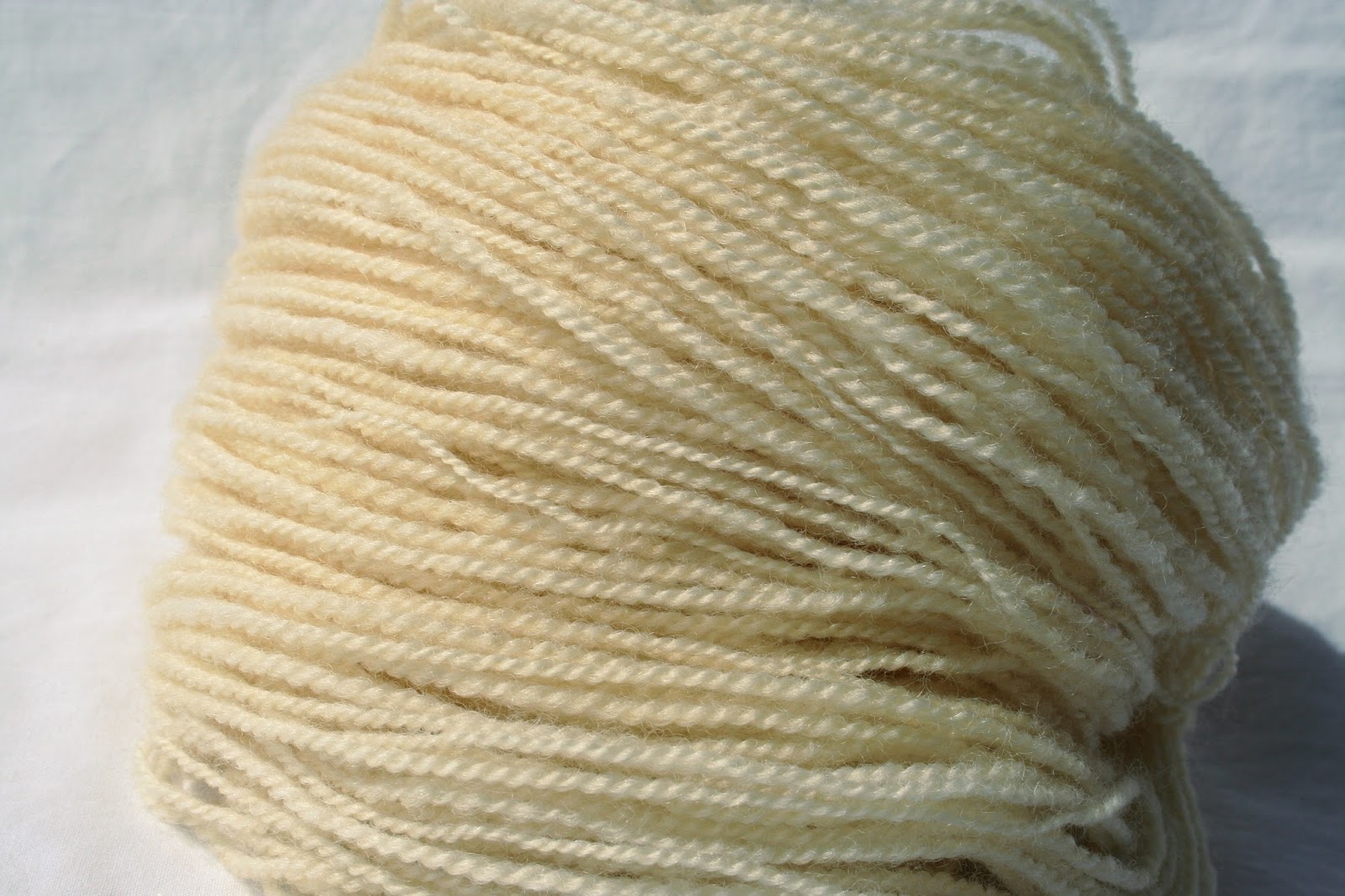
I kept a light hand while drafting and made sure to keep the twist on the light-to-medium side. After spinning my cormo, I really loved putting extra twist in the ply, rather than the singles, to make a durable yarn. Since there is a lot of spring in Suffolk, I decided to spin the worsted preparation into a med-low twist single and ply the singles on themselves to produce a 2-ply true worsted yarn with the light airiness of a yarn made from carded batts. Here is the resulting yarn:


It's roughly a sport to DK weight yarn (due to bloom after washing), 168 yards and 52g. It's incredibly soft and squishy, and I would liken it to the cormo I spun earlier. Suffolk can range in fineness from 25-33 microns (according to the Fleece and Fiber Sourcebook), so if you're looking for a soft Suffolk for close-to-skin items, it would probably be best to buy a fleece in person or buy from someone who sells handspinning fleeces (some shops will even estimate the micron or Bradford counts).

Based on everything I've read, Suffolk is a medium-to-hard wearing wool (depending on micron and spinning technique) and wonderful for heirloom sweaters and the only hat you'll ever need to make. Or so I hear. :) I still have a ways to go before I can be competent with the ways I can use Suffolk, but I wanted to bring light to this understated wool--meat sheep tend to get overlooked by the handspinning community because the emphasis isn't on fleece quality or consistency. I will be weaving this, along with some other undyed wools, into a lap blanket, as soon as I get my hands on a new rigid heddle (<--- guess where I left mine). Have you worked with Suffolk before? Share your experiences in the comments below!  

Thursday, June 18, 2015

Review: PLY Magazine Autumn 2014 Issue

This particular issue of PLY magazine was interesting. The theme was Community, and what that term has meant through time. When I first bought this issue, I wondered how the theme would teach me both about fibers and the fiber arts community. I mean, on the face of it, I know what community means as it relates to the spinning community or the weaving community. PLY magazines so far have been based around spinning techniques, preparation methods, and breeds, so this issue seems a bit anachronistic. But let's see how it fits into the other PLY themes thus far.


In other issues of PLY, there is usually an article some historical (or even prehistorical) connection with fiber arts. Within a community of herders, crafters, bakers, mothers, fathers, and so on; you'll have weavers, spinners, and dyers. Specifically, we want to know more about the spinning community among these ancient peoples. Spinning was a more integral and critical part of their lives than it is for us today, but their spinning circles were probably very similar to ours today. We gather, spin, chat, and help each other. We welcome and inspire new spinners. We help older spinners who may not have the strength to card their own wool anymore. In that respect, the spinning community is an ancient one, and though we may spin soy fiber and dog hair, we are very much the same community we always used to be. The article about Mesoamerican and South American spinning communities (written by Christina Pappas) delves more specifically into this idea of community.


Then there's the idea of subcommunities, living within the general category of spinning community. Shetland wool was presented because it a challenging wool to categorize, based on the terminology used, variability of the fleece itself, and the confusion of labeling in commercial products. My own personal experience with Shetland has been full of frustration (annoyance, maybe?) because I couldn't understand what Shetland was. Every time I got an explanation from one person and moved onto the next, it was like I was hearing about a different animal. Deb Robson, author of the article Shetland Wool, concisely describes the plethora of characteristics you'll encounter when you step into Shetland territory--it is very much its own community, full of those who are familiar with the language, textures, and capabilities of the wool. But the language they do speak is the same all spinners speak: if you want to know more about Shetland, their eyes will light up and they will be pleased tell you everything you need to know about Shetland wool.


One article in particular struck me personally, since the project fits within my own mission. I want to increase public awareness for spinning, dyeing, knitting, fiber arts, and wools. If anyone is willing to give me 10 minutes of their time, I will teach them how to spin. Robyn Love wrote about her project, Spindle 7, where she rode a New York train (the #7) and spun on her drop spindle. If anyone expressed interest, she would teach them to spin, and if they wanted to keep going, she would send them off with wool and spindle. There is a great diversity of languages and cultures who ride that train, and she talked about how those experiences effected her. You don't need to speak the same verbal language to teach someone to spin, since the language being spoken is that of: draft, twist, yarn.

And then there are modern communities, those of us who digitize our stashes on Ravelry, who blog our experiences in lengthy posts, who drag our friends to fiber festivals, and who drive an hour to spin with guild members in the next big city. We come together and spin for charities (like Spinzilla), we share our sports spirit when we challenge ourselves with our favorite cyclists (like during Tour de France/Fleece), or when fellow spinners are going through financial/emotional/medical hardships. Our community spans across socioeconomic barriers, gender barriers, and language barriers, With the Internet, we can have a thriving global community and share in traditional styles and techniques of other places in the world. You aren't alone. We're here, and this issue really shows that.


As far as colorwork, techniques, and patterns goes, this issue is also packed full of those things which will boost your knowledge about fibers and some ways you can use them. But if you're wondering about what our spinning community is, where it is, and how to be in it, this issue is definitely for you. My original skepticism vanished as I continued to read this issue. Sometimes we need to sit back and see what our spinning community is, how it has grown/diminished/morphed/shifted/changed, so we can be comforted by it when things don't go well, with whatever life throws at us.


If you need a community, we're here on Ravelry.

Monday, May 18, 2015

Review: PLY Magazine Summer 2014 Issue

This issue was all about twist. I don't consider twist so much when I set about to make yarn. In principle, I do consider twist, but I don't actively think about twist as a primary aspect of my yarn. I tend to make my yarn organically, meaning that I just let the fiber speak to me and spin it so it feels right. That doesn't translate well to others, so it's important that we can talk about twist objectively. That's exactly what this issue does. Since I can't reprint the whole issue here, or write a summary which does the topic justice, I will say that you ought to buy this issue if you want to make consistent yarns, no matter what fiber you're working with--especially if your fiber preparation contains a whole slew of different fiber lengths and micron count. So, I will be talking about the articles which made me think the most.


First up, we have "Intuiting Twist" by Lexi Boeger. She challenges the reader to blend up (by hand or hackle) a wide variety of fibers. Don't hold back--anything goes, so long as it falls outside of your comfort zone. As you spin, pay attention to how much twist the fiber is willing to take, then allow it to be taken up by the wheel. The uptake won't be at a consistent rate--it's dependent upon the specific lock you're spinning...and it's okay if you can't remember which lock it is! The point is to observe how much that particular length of fiber wants to take and not overdo it.


I tend to do this when I have a carded batt which is made of long sari silk bits and shorter merino bits, but this is clearly an extreme example. I've been spinning fiber hackled from bits and bobs, including bits of yarn. Here's the art roving I made (will be part of a video soon!):


The next article I found most interesting was a collection of tips from Amelia Garripoli, of Ask the Bellwether, There are some incredible little bits which you learn along your path as you dig deeper into the mechanics of spinning. These tips are gold, and are often the kind of things you learn when you talk to master spinners (whether they have a certification or not--experience is the operative idea here) about specific topics. My extra little tip to add: Don't spin a difficult fiber when you're frustrated, angry, or upset. If spinning isn't helping to calm you down and relax you, spinning while you're agitated will only result in bad yarn and many regrets.

The last article I want to touch on is "Tame Your Yarn (by setting the twist)." At some point, we get into a routine: draft, twist, ply, wrap, set, knit. But what purpose does setting have in reference to yarn? Well, this article by Stephanie Gaustad delves into the reasons for setting, as well as pointing out reasons why you might not want to set the yarn. Additionally, she talks about setting the twist for different fiber types, for protein and cellulose fibers.


Setting the twist dramatically impacts the look and feel of the yarn, but it also affects the fabric it produces (as you can see in the incredibly biased swatch above). So, though you might be locked in a routine where you set your yarn before using it, why not look for projects which would look interesting with an unset yarn (Stephanie suggests: collapsed weave scarves, hemp/flax scrubbies, or even lace projects).

I probably won't consider twist much more than I already do, but I'll add it to my process when I spin large quantities of yarn which require consistency. I am tantalized by collapsed weave projects, so now I want to make some gauzy scarves that have a lot of visual interest...this time, the interest comes from the weaving process rather than just using textured yarn.

There you have it, another great reference magazine that ought to be on your shelf. At first, I was a bit skeptical that PLY would take my heart and run away with it, but I am truly smitten with them. I come away from each issue informed and eager to try at least one new thing. If you have been a contributor to PLY, I want to thank you for helping to build such wonderful reference material which is accessible to every spinner!

Wednesday, April 8, 2015

Review: PLY Magazine Spring 2014 Issue

Back in January, I set aside time to do all of my magazine reviews so I was all caught up, but for some odd reason, I completely forgot. No, it's not my age...I think I should write down the lists for things I need to do all in one spot, instead of keeping to-do lists in a couple of different places. So, this review is about 3 months late. Forgive me! Regardless, this issue, the Silk issue, is totally worth reading, no matter when my review of it comes out.

Where to start. I always get fired up after reading one of these issues and each issue has so much content that it's difficult for me to keep my review on point. Afterall, what's the point of me re-writing the whole magazine in summarized form? I've stressed several times before how crucial it is to put lots of relevant pictures into a magazine of this type, and they surely delivered, again, in this issue about silk.


Today I learned that I don't know much about silk. Sure, I knew about it's properties, keeping you warm when it was warm, and keeping you cool when it was cool. And I know about how much silk you need to make a shiny wool blend. But I didn't know there was an anatomy to silk cocoons. But first, let's talk about from where the silk comes. It is extruded from the mouth of a silk worm, liquid in form and then extruded, solidifying as it becomes exposed to the air. And there isn't just one kind of silk worm, there are at least four kinds which are used with high demand. Bombyx, comprising the majority of the silk world, tussah, the warm champagne silk which comes in a far distant second contributor to the silk world, eri, otherwise known in India as 'poor man's silk', and muga, a dark, fantastically golden silk. Much of the silk which falls into our hands as combed top is actually the not-as-good silk leftover from silk reeling.

The first article I want to talk about is S, Z, and Why? because it addresses an issue of twist and determines whether silk has a good side, or if twist direction carries no significant impact. Why do we twist yarn in the Z direction and ply in the S direction? Well, there might be hidden reasons for spinning a fiber one direction rather than the other but we don't consider them because we're used to spinning silk only one way. PLY is about taking established notions and turning them on their head, all in the quest to uncover the 'why' of X or Y; I love that, and the scientist in me gets all giddy when they experiment with established notions. All four types of silk were spun for this experiment, where each silk type were spun in both ssZ and zzS plied yarns. ssZ is short hand for s-spun singles and plied in the Z direction. The author makes several insightful observations, and it was shown in this experiment that twist/ply direction impacts spun silk in various ways. It was a fascinating read and I plan to get some silk to try this experiment for myself after our cotton spinning challenge is over.


I just had to throw this picture of natural dyed silk into this review post. If you get the chance to do some natural dyeing, definitely make silk one of the things you dye. It's very cool to see how the different silks took up the dye colors...they're not all equal!


This next article, Science in your spin: silk under a microscope, there is some technical jargon which might be difficult for non-science readers to completely understand, but it is written for all audiences. I read it twice because I don't typically work with molecular sized artifacts. This article unpacks the differences of between the silks on the molecular level so we can understand why they're so different. The feel different, for a reason. They shine differently, for a reason. And it's all explained in this article. The coolest tidbit I got from this article is the fact that tussah silk has microscopic striations along the fiber, which is probably why it is referred to as a 'toothy' silk...and probably why I have so much more success spinning it the way I want, as opposed to mulberry (bombyx) silk. Remember when I mentioned that silk cocoons have an anatomy? Evidently, the silk thread becomes thinner as the worm spins his cocoon, so that the exterior silk is thick and weak and the interior silk is thin and strong, and the crystalline structure of the silk as it's extruded greatly impact its thickness (or in the case of bombyx silk, thinness).


The last article is one which is dear to me, because it basically told me I'm not crazy. Years ago, I made a silk/cheviot blend yarn, and you can still find it on Etsy (someone, please buy it! lol). When I was first getting started with blending my own wools, I received a lot of negativity in regards to my idea of blending a fiber like silk with a medium coarse wool like cheviot. I thought it would emphasize the best qualities of both types of fibers, yet others professed that it was a waste of silk. The article Calculating the Silken Ratio experimented with adding silk to various other fibers, in this case, wool, to determine which ratio is the best to bring out the desirable qualities of the ingredients. The wool you're bringing to the mix has its own luster and behavior, which goes into the calculation for determining how much silk to add to achieve the desired result. BFL and silk is a common blend, and you'll typically find it in an 85/15 or 80/20 BFL/silk blend ratio, because BFL is already a lustrous wool. Fine wools tend to be less lustrous due to crimp, so more silk is needed to achieve similar results. So, the next time you find yourself standing at your blending device with silk in one hand and wool in the other, give it a blend and see how it turns out.


There is so much more information in these hundred pages than I can justly review here. If I could, I would break this a 3-part review...but I can imagine that many of you are inspired enough to hunt down this copy for your resource library; and I can't blame you for it either! I have one more PLY issue on my bookshelf to review, so I'll get that done this month. I'm three issues behind the release schedule, so it's time to order some more! I can't wait until I'm a bit more settled so I can just get a subscription. Stop by my Ravelry group, Expertly Dyed Friends, to discuss this some more!

Friday, February 13, 2015

Review: Spin-Off Magazine Fall 2014 Issue

And, here we have another issue to talk about! I'm nearly caught up with the Spin-Off magazines, but then I'll need to double back and work on the PLY reviews. This issue had a few interesting articles about mechanics, but I didn't find it to be as strongly a connected theme as the last issue was. If you want to know more about the tools of the trade, and how to fix them when they don't work quite right, this issue is great for that.


The Winding Well article is superb for those who have difficulty understanding how to wind fresh yarn onto a drop spindle, building a firm and stable cop as you go. I learned the hard way; there is a clear best way to wind the yarn onto the shaft so it doesn't get loosey-goosey (or worse, the outside yarns get buried deep within the inside yarns). No matter which spindle type you use (top, bottom, support, etc.), the X wind on will make your spinning experience smooth and problem-free. Additionally, the author discusses the proper way to wind on freshly spun yarn so you neither add nor subtract twist from the yarn. It seems like a simple fact about spinning, but it often gets overlooked. Have you ever had the toilet paper on the roll suddenly start unrolling, only to stop short of completely emptying onto the ground by the glue on the cardboard roll? Right, me neither. Anyway, this picture shows what you're doing when you change the orientation of the spindle when you wind on yarn:


Several people have asked me about blending boards, and I have professed that they fill a specific niche, which lies somewhere between hand cards and drum carders. There are things you can do with a blending board which would be difficult to reproduce with the other tools. It's not just a cheaper version of a drum carder, nor is it an oversized hand card. Blending boards really shine when you want to make several rolags at once, with lots of color blocks and well-placed texture. If you want to know more about the testing process, this article offers an abridged view of all three tools in making these kind of rolags.


Ever since I began weaving, I became more interested in the weaving patterns in the Spin-Off magazines. This Autumn Leaves scarf/shawl is stunning in its simplicity, though I have to admit, I don't really understand how to make an inlay while weaving. Even after reading the instructions twice, I still don't think I comprehend. Oh well, that's why the Internet invented YouTube. Nevertheless, I think this weaving project is within my weaving skills--ie, beginner. I'm still not sure how I feel about the length (it seems a little short), but it does seem like a cuddle-worthy shawl.


In the end, I think this issue is most useful for those who are interested in tools, their use, and reuse (ie, antiques). If you're just getting started with spinning, this article may not be the best reference, though there is a great article about up-take speed and tension for those who are thinking about getting a spinning wheel. Care to share your responses to this issue? Share the discussion below or over on Facebook. 

Wednesday, February 4, 2015

Review: Spin-Off Summer 2014 Issue

So, I really liked this issue of Spin-Off. The theme for this issue revolves around the fibers of the world. I like learning about the history of fiber in various regions of the world, and their associated spinning/weaving/knitting traditions. We don't always have the luxury of visiting these remote locations to see the traditions spring alive, and this issue takes you on a whirlwind journey to several countries, though time as well.


Historically, my reviews contain my personal response to a subset of articles. But, since I'm writing this post after I already posted about Icelandic wool, I would like to do a little more than just a review. Now, I probably know only a little more than the average person about Vikings due to my background in the archaeology of Europe. But something I don't know about, is what remains of their legacy in Iceland. When Iceland was settled by early Vikings, they brought with them sheep and goats, among other household tools and goods. More importantly, they brought with them their fiber crafts, some of which have experienced a recent revival.


Only Icelandic sheep are allowed to live in Iceland, which means no other sheep are allowed to be imported--to wit, they're a national treasure. Iceland evokes images of a primitive, bucolic setting where sheep roam hills, living happy, healthy lives. And the result is in their fleeces! According to the authors, Marianne Guckelsberger and Robin Russo, Icelandic sheep produce the finest, heaviest fleeces if shorn in the fall. I shall add this to my list when I go hunting for a pound or two of Icelandic fleece! What's more, these sheep are the direct descendants of the original sheep brought to the island by the Vikings, more than a thousand years ago.


However, as much as the Icelandic sheep thrive, the Icelandic goats wither. Their numbers plummeted and were only recently revived, but due to their relative obscurity, their existence is in a fragile state. I like to be onboard with conserving rare breeds of sheep and goat where I can, so I was very pleased to discover that shortly after the release of this issue, an Indiegogo campaign was launched. It was well-received, and due to everyone's contributions, the herd will be safe for a while longer. That said, it is by continued exposure that breeds like these stay as close to the spotlight as possible. I gleaned more history from this article than I have from other sources. Additionally, I liked the extra story to boot.

The next article I want to share is the one regarding flax. I've been swayed by the romanticism of raising/growing my own fiber animals/plants, and flax is one I've had on my list for a few years. If you want a hobby patch of flax, this little article offers plenty to get you started. Better yet, if you want to teach your kids the great value of farming, you can grow your little patch for multi-faceted learning. Harvesting flax at the perfect moment produces a soft, pliant fiber, ready to be spun and woven into the finest of linens. Though, to get this fine cloth, you have to sacrifice the plants ability to reproduce--that is, you harvest before it can go to seed. Obviously, you can't just only grow flax for linen, since you'll quickly run out of seed. This is where the valuable learning lesson comes in: when do you decide how much to harvest to use and how much to save for future plantings. What about food? If flax is allowed to seed, it produces a coarse, rough fiber, more suitable for bags, ropes, and the like, not necessarily for clothing. Something I learned when I was young was to appreciate handmade items, having learned how to stitch and sew by the age of seven.


The purpose the authors intended was in a similar vein. They wanted to show the community all of the steps involved in making flax into linen, and the community reciprocated by helping out during certain phases. The best part of their project was the resulting public awareness.

The last thing I wanted to comment on is in regards to the forgotten spinning traditions of the Native Americans of the Southeast. We don't often hear of such traditions from this part of our nation, mainly due to poor preservation conditions (it's humid, but not the right kind of wet needed for wet preservation), the delicacies of the craft itself, and, perhaps, a milder interest than in other parts of America. Nevertheless, preservation of textiles does occur, though of impressions rather than in the actual artifact. I've mentioned this before in my discussion of warp weighted looms. It is quite fascinating to see the great variety of impressions, while also knowing that people were pressing fabric into clay in the New World and the Old World, though cultural contact between them was unlikely to have been the cause of the inspiration.


While it is interesting to me to read what other archaeologists say about textiles who are textile artists themselves, what I do not like to read is that "archaeologists ignored the textile traditions of the southeastern United States because they could not find many textiles" (Pappas, 2014: 43). It seems like such a small thing, to say that archaeologists ignore something, but I like to have the record straight: no doubt, this is one of many reasons why the textile traditions of the southeastern US are understudied. Unfortunately, these kinds of words can be poisonous to my profession, which is why I generally don't approve of tv shows which angle scientists negatively--usually, they get something wrong, and it perpetuates in the public's opinion. So, I hope that when/if you read this particular article, you keep my comments in mind. Archaeologists are just as passionate about their work as you and I are about wool and yarn. And for me, that's doubly so!


Well, I hope you enjoyed this slightly different review of a (semi) recent Spin-Off magazine. If there's anything more you would like to share, post in the comments below, or over on Facebook.

Pappas, C. (2014, Summer). Forgotten tradition: spinning prehistory in the american southwest. Spin-Off Magazine, 38(2), 42-45.