Showing posts with label introduction. Show all posts

Tuesday, August 27, 2019

Iron Age Archaeology and Textile Studies: Where have I been?


Hey everyone!

I know it has been so, so long. I haven't gone missing, or gotten distracted. But I have had a severe shortage of time. I've been thoroughly engrossed with my PhD research on textile production during the Iron Age of Britain for the last few years, which has also meant that I haven't been able to do many updates. I worked on relaunching the Expertly Dyed shop last year (my big New Year's Resolution), and I had quietly vowed to relaunch my YouTube channel this year.

Over the coming months, my plan is to reacquaint myself with the past avenues I've used to share my knowledge. It'll be a rough start, but we'll get there. To start, please watch this short promo video so you know where I'm going to start off with.

Iron Age Archaeology and Textile Studies

I also plan to work on some Fiber Talk videos. Living in the UK has given me the unique advantage over my time in Korea to explore a wealth of fibery goodness. There are tons of rare breeds available to my fingertips, and I've already been underway with testing and spinning them. So, please stay tuned for those future videos.

I'll also use this blog to link some of the content I've already created from conference papers I've presented. Having been on both sides of the academic paywall, I'm well aware how difficult it can be to access certain information. For those interested parties, you can find most of my work (until 2018) on my Academia profile. If you want an easier digest of my research, I will be posting versions of my work here, without all the academic puffery that is sometimes needed to show peers that you've done the research. I hope that these two options will be ideal for most of my audience, but if you're still interested in my research and have no idea how to understand what it all means, let me know. Knowledge is useless if you can't properly share it. I'm happy to do this for you.

Thank you to everyone who has supported me during these last four years. It's been a bit of a dead zone in terms of content, but it doesn't mean that I don't miss everything about textile arts, and the Expertly Dyed community in particular. Reading through old comments has lifted my spirits. :)

Places to find me:

Email: expertlydyed@zoho.com
Etsy: http://www.expertlydyed.etsy.com
Facebook: https://www.facebook.com/expertlydyed
Twitter: https://twitter.com/JenniferBeamer2
Pinterest: http://www.pinterest.com/edexpertlydyed/
Instagram: http://instagram.com/expertlydyed
Ravelry: http://www.ravelry.com/groups/expertly-dyed-friends

Tuesday, March 25, 2014

The New Ply Magazines Have Arrived!

Spin-Off magazine has be the foremost magazine available to spinners who want to be part of a community and learn more about their craft through the experiences of others. As a commercial magazine, available at many craft stores around the world, it has become a popular choice for spinners to read as each issue becomes available. There are other, slightly more academic, peer-reviewed journals which discuss various aspects of spinning, about it's history, but those aren't typically available on the commercial market--to access those, you must pay for a subscription. Occasionally, there is a brief mention about spinning in knitting and crocheting magazines. Herein lies the perfect balance between the content you'd get from a Spin-Off issue, and that of paid subscription to a peer-reviewed journal: Ply magazine. It has a structured overview with well-written, fluff-free articles which teach the reader in a very reproducible, scientific way. I'll explain all what I mean in a later blog post, but I wanted to talk about my first impressions of the magazine.


First, the magazine itself is printed on sturdy paper, with a completely different feel than magazine paper. This attention to detail, whether intended as such or not, makes me feel like the content I'm about to read will be flipped through many times, so heavier paper is needed for durability. The coverart decidedly makes me feel less like I'm reading a magazine. The sleek, unobtrusive cover allows me to see the art for what it is and easily know the contents of the issue (Color, Woven, etc.). After a quick flip and skimming the contents, it becomes apparent that great attention was paid to unifying all of the diverse content together with theme other than white pages.

The advertisements in Ply are well integrated into the pages, and I rarely feel like I need to skip over them. There's a rare page or two of nothing but advertisements, but on the whole, it seems like they are either fewer in number than Spin-Off or placed such that I don't notice that I'm being sold to. I really like having advertisements nearby an article, yet unobtrusive. I realize the importance and necessity of having advertisements in a magazine, however it can make me feel like I'm watching regular cable television--I'm way more likely to skip past pages of advertisements rather than read them.

Overall, it seems like the content is updated. Though it focuses on a specific theme, in this case, Color, I think it reflects many of the questions I get asked about color blending and how to spin batts/roving to achieve various color effects. I find this to be a bit of a surprise, given the fact that this is a printed resource--often, printed sources tend to be behind the times. The salient questions about color are addressed, and since the advertisements are played down, I feel like I'm both getting plenty of content and the pictures they use show me exactly what they're talking about. In some ways, it looks like a teaching manual.

Last, the price. I must admit, I wasn't too sure about the steep price. I bought mine from a store in Japan, Kakara Woolworks, since Yuka was the closest store to me who had copies (and thus the cheapest shipping price). For me it was USD $16 an issue, but a subscription for US addresses is $9 an issue (and probably around $10 an issue if you buy it at a store). That is certainly more for 4 issues than Spin-Off, which is about $6.50 per issue. My cursory look has given me confidence that I paid an appropriate amount for the extras offered to me in each issue, so if you might be on the fence about purchasing a copy (or getting a subscription), I'd say it's worth examining personally.

I'll be working through each page, each article, so I can write up a review which takes a closer look at the actual content. I do this for every Spin-Off magazine too, and with the new issue for Spring arriving soon, I'll soon be able to compare the content of each magazine. And as a side note, I don't dislike Spin-Off. It's a typical magazine in terms of its layout, and I learn many things in every issue I have, which starts in Spring 2010. I've even read the older issues from the late 80s/early 90s that my guild library had. I just think Ply is heading in a new direction and really speaks to me as an avid learner, plus it seems like a strong contender for the market. It's nice to have choices, and I think Ply offers a healthy amount of competition. In all likelihood, I'll subscribe to both, especially since I know that many of you come to me with questions and I like helping out in any way I can. Anyway, stay tuned for more about Ply magazine! <3

Saturday, November 2, 2013

Meet the Crafty Academic

Hey there everyone, welcome to my new blog! To introduce myself a little, I’m a 29 year old spinner/knitter/designer/dyer/wife/martial artist. Like many of you, there’s a life outside the crafting world, and no matter how you try, some nights you just fall asleep with a ball of yarn (or fiber!) in your lap. We have so many daily demands that our creative spirit just disintegrates, leaving an exhausted husk behind. Drastic imagery, but you get my point. While we’re waiting in line at the grocery store, at the bus, or during our lunch break, we whip out our smart phones, tablets, what-have-yous and veg out for a while. Among my sparse ‘veg-out’ time, I look at what other people have made and try to design my own version. Sometimes, I have a vague idea for a new kind of this or that, then I spend the next hour or two slopping through the creative phase. Sometimes it works, sometimes I have no idea what I did wrong (or need to learn how to do) so I turn to the internet for help. Let me be one of your many go-to places for inspiration, ideas, and troubleshooting.

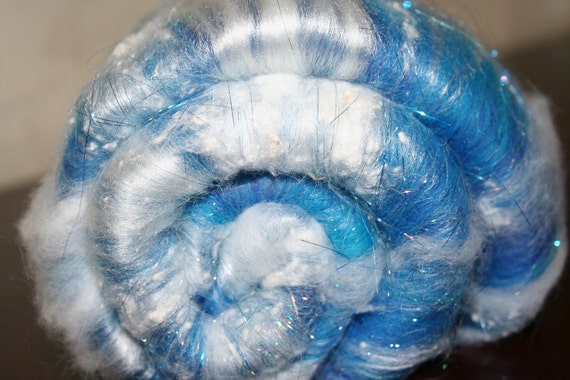
A Cloudy Day - Expertly Dyed Batts Limited Edition Colorways
But I’m getting ahead of myself--there’s more to me than that. We're all complicated people, and I’m an academic at heart. I got into spinning initially by doing it for my master’s degree. No, no, it wasn’t in something you’re probably guessing--it was for my museum studies dissertation. I did the whole spinning, dyeing, and weaving thing to create surrogates for real, archaeological samples. Why? Well, I was going to shoot lasers at them to specifically damage them. So, no museum would let a grad student without funding destroy something irreplaceable--which brings me to my current obsession.

Because of my innate spirit to teach, I began making youtube videos and blog tutorials to help fill a void on the internet. When I first began searching for videos on spinning yarn (back in January 2010), there was only a small handful of videos that were worth watching. Many of the videos were short. And hard to see. And some played _terrible_ music in the background. After gaining two years of spinning proficiency, partially under the guidance of a master spinner, I began sharing my knowledge with the beginners out there. And the soon-to-be-beginners.

Now, how does this fit the academic connection? Disseminating information is one of the most important attributes of being a professional academic. Who cares if you’re full of revolutionary or controversial ideas if you never share it? Or worse, some grant-giving agency has given you funding for research/excavation/etc., and you never publish--that’s a huge thorn in everyone’s side. I see myself as a budding expert in spinning and dyeing, so my academic background urges me to disseminate this information to the rest of the world.  I want to share what I know about these crafts to keep the spirit of the handmade movement alive and thriving. In so doing, I have instilled in several others the desire to spin and dye.

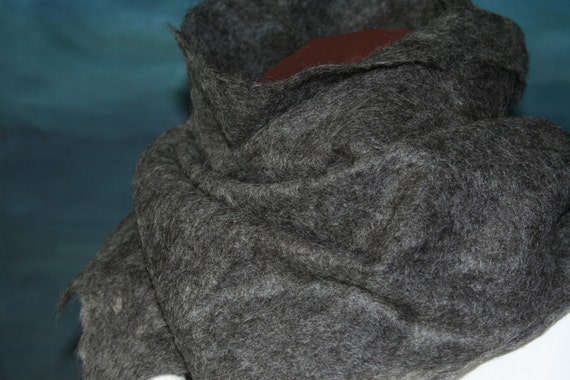
Handfelted Alpaca Triangle Shawl - Expertly Dyed
And as with any good academic, I realize that I’m presenting opinions (albeit, based on experience, science, and research) which can conflict with others. If I have presented something on this blog which you think I have wrong or haven’t explained properly, by all means, please let me know. It’s an opportunity to grow as a person and learn something new about myself and others.

This isn’t my first blog experience. In fact, I had a website once, with a blog and everything. It was created by my husband from scratch, but over the last few years, my business has grown and changed. And with that, so did my needs. Over the next few months, I’ll be re-posting some of my more relevant blog posts from my former site, in addition to posting new material. Some of the tips and tutorials I created on that site were too good to be lost to the internet! I'll be back with tips, tutorials, and large-scale projects soon. :)

Thanks for reading everyone,
Happy Crafting.

Jennifer Beamer